
INTRODUCING THE CHRYSANTHEMUM
(continued)
One of the things that gives such great diversity to chrysanthemums is the many different characteristics of the disc and ray florets. There are some thirteen general types of exhibition chrysanthemums. The simplest, "singles," have a visible disc surrounded by a row of rays, and are basically flat. These are closest to the original wild chrysanthemums of China from which all exhibition, garden, and commercial varieties descend (the genus and species is "chrysanthemum indicum"). "Anemones" have a prominent disc and subordinate rays. Then there are the many varieties in which the rays are prominent and the disc is invisible within. Within this group, the florets may curve upwards ("incurve") or down ("reflex"), or some combination of the two, and form a mound. Finally, the rays may have unusual shapes, giving us "spiders," "quills," "spoons," etc.
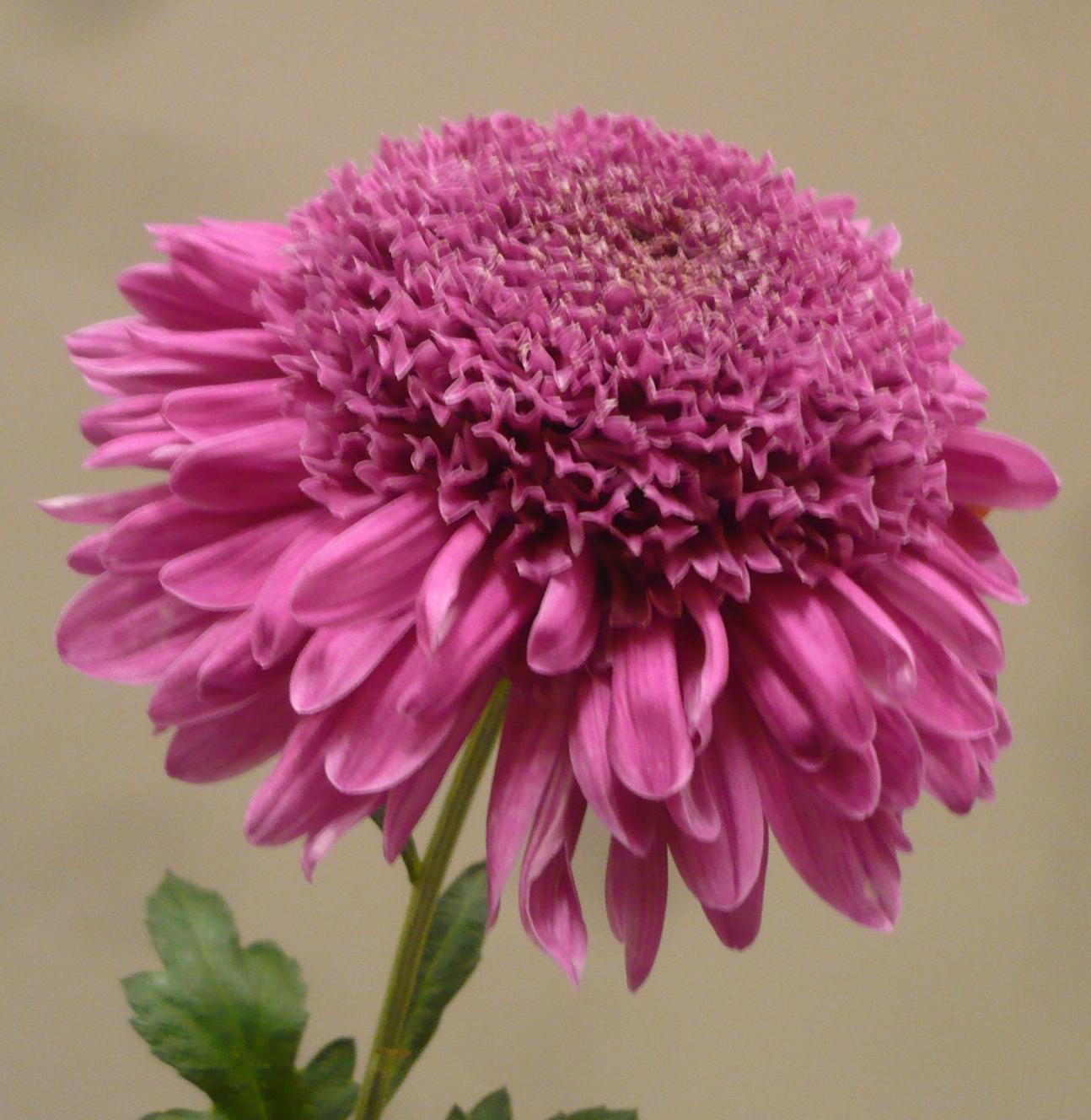
PURPLE LIGHT, EXHIBITED IN 2010 BY WALTER SOKOL
Another thing which gives chrysanthemums such exceptional diversity and beauty is the variety of colors. The original chrysanthemums were yellow, and the word "chrysanthemum" itself was coined by Linnaeus from the Greek words for "yellow" and "flower," but now mums can be bronze, pink, red, white, or even green. Some singles may have discs of one color and rays of another, and the rays themselves may be more than one color. Each variety or "cultivar" of chrysanthemum is a distinct color and type. For example, you will probably see a beautiful variety of mum called "Purple Light," which is a purple anemone (see photo to right).
Chrysanthemums may be grown in quite a variety of ways. Around public and office buildings, and perhaps in your own yard, you will find varieties that are large plants covered with small flowers, providing a sea of color in the landscape. In our show, you will mostly see a single, large (as wide as ten inches) bloom on one stem. This is achieved by removing the side buds and stems so that all the energy of the plant goes into the one flower, thus the term "disbud." Another way we grow chrysanthemums is to have a cluster of small flowers called a "spray."
Mums are displayed as cut flowers or entire plants. Each cut flower entry may be one disbud or spray, or three disbuds or sprays of the same variety. The entire plant may be an entry, grown as a bush, a tree (with a "trunk" of six inches or more), or a huge structure known as a "cascade." Miniature chrysanthemums are part of the bonsai world, a whole other highly specialized way of growing mums.
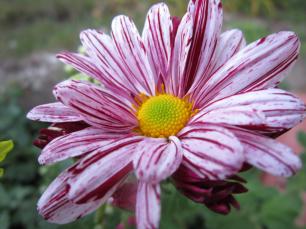
AN AMAZING SINGLE CALLED "ARTIST PINK"
To make sense of all this, there is a structural document known as the "show schedule." Last year's LICS (Long Island Chrysanthemum Society) show schedule is some six pages of small print, dividing the entries into some nineteen sections and innumerable groups, classes, and even sub-classes. The show is judged by expert growers from outside Long Island who are certified judges and may even rise to the level of "master judge." Each cut bloom or plant is judged according to specific scales, and foliage counts as well as
the bloom itself. Ribbons are awarded to superior flowers, and higher awards are given to the best entries in a group, section, and even the entire show. Each award is worth a certain number of points, and the grower with the highest total p;oints earns an award called "sweepstakes." A judge may enter flowers in the show as well, but those are placed in a special section and are judged by Long Island's own expert growers, who may themselves judge shows in other parts of the country.
Finally, we hope you might be inspired to grow chrysanthemums yourself. While the whole process may seem incredibly complex, "the chrysanthemum is a weed," as one of our members pointed out a few months ago, meaning that, by and large, if you give your mums enough water and grow them with plenty of light and in good topsoil, you will get plenty of beauty and nice cut flowers, whether or not they rise to the level of "show quality." If you would like to join the society, we will help; you to achieve whatever level of mum growing you might aspire to, and you should consult the bibliography of chrysanthemum books on this site for further guidance.
You may well ask "Where can I buy the seeds?" Yes, as we explained above, the chrysanthemum produces flowers for the purpose of giving rise to seeds, but they are almost microscropic and difficult to use, not to mention not always true to variety, as the mum flower structure does not lend itself to self pollinating. That bee or other insect who lands on a particular flower is likely to carry the pollen to the pistil of a completely different variety, and the seed that results may give rise to a hybrid combining the worst qualities of the parents, etc. However, the normal way to obtain new plants is to buy very young plants in the spring by mail order from King's Mums in Oregon. These plants are "cuttings" from stock plants, and thus are vegetative and true to variety. Also, you may be inspired to purchase some of the beautiful mums for sale in the Fall at Hicks, but be forewarned that, although the chrysanthemum is indeed a perennial, a few weeks after it blooms it will die down to the root clumps, and if you can successfully winter them over, the root clumps will send up new growth in the spring. Then King (or you can do it yourself at home) will make cuttings from the growth of their own root clumps. Fortunately it is relatively easy to root cuttings and make new plants, and of course you can grow plants directly from the root clumps without making cuttings, but cuttings will give you the best results in the end. This should not deter you from buying those beautiful plants at Hicks. Just do not expect the flowers to last for more than a few weeks.
Of course this little essay just touches on the most basic knowledge of how chrysan-themums are grown and displayed, but if it enhances your enjoyment from just looking at the flower or even starts you on a very satisfying and interesting hobby, it will have served its purpose.
Copyright 2011 by Joel R. Simon. All rights reserved.
RETURN TO THE BEGINNING OF THIS ESSAY
RETURN TO THE LICS MAIN PAGE
